


Inside Interstellar Arc: A Journey Beyond VR’s Limits
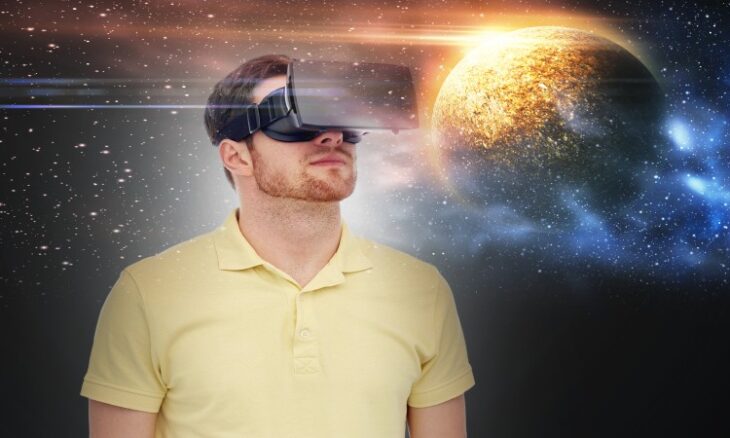
Time passes with startling speed in Interstellar Arc, an experience that frames a leap of 260 years as a momentary transition. The journey begins on a virtual version of a failing Earth far in the future and ends aboard humanity’s new refuge, a vast orbital structure. Inside a warehouse outside Las Vegas, visitors put on a headset and find themselves transported instantly. Moments later, an artificial fox rendered in bright blue light appears, taking the form of a guide designed to explain centuries of human history and the project’s broader aims. The creature remains a constant companion throughout, even when attempts to engage with it go unanswered due to the limitations of the technology.
The guide alternates between its fox-like appearance and a human avatar with an unnervingly calm expression, shifting seamlessly between forms as it leads visitors through an expansive station built to represent a complete archive of human culture and knowledge. The setting, though meticulously crafted, has no physical substance beyond the metal railings that prevent visitors from colliding with one another. The real room is a largely empty blue space, and the illusion depends entirely on the headset’s projection.
Interstellar Arc is part of AREA15, joining other high-profile attractions intended to move visitors into elaborate fictional worlds. Unlike installations that rely on physical construction, the Arc opts for a near-total dependence on virtual reality. This choice becomes obvious whenever the headset is lifted, revealing the bare environment supporting the digital landscape.
The experience demonstrates both the scale and the limits of VR. Over the course of an hour, visitors appear to move through a circular route spiralling around the station’s core structure, achieving a sense of drifting in defiance of gravity. The guide directs them to clusters of glowing orbs and delivers explanations about the mission to settle a distant planet, while warning against the mistakes that pushed Earth to collapse. A colossal virtual figure modelled on Carl Sagan briefly appears to outline the astronomical principles behind the project, transforming the experience into something resembling an educational programme embedded in a game-like frame.
Yet Interstellar Arc raises questions about the long-term potential of VR. Although ambitious in scope, the presentation often lacks emotional depth. The visuals appear slightly blurred, and any sense of physical presence is dependent on holding the railings. Much of what unfolds feels insubstantial. Motion sickness is thankfully limited, but the world rarely gains the tactile or atmospheric conviction needed for real immersion. One striking moment features a torii gate facing a sunrise over Mount Fuji; stepping through it floods the surroundings with golden light, creating a fleeting sense of genuine wonder. Apart from this, much of the visual design resembles a generic science-fiction template.
Despite its futuristic narrative, the Arc maintains a serious tone, offering a methodical account of how humanity might migrate to another world. Its sincerity is clear, though the presentation can feel dry, relying heavily on the novelty of full-surround VR rather than engaging storytelling. The experience avoids spectacle, favouring earnest instruction, though this leaves extended stretches with limited emotional variation.
Attempts to incorporate interactive elements include collectable orbs that behave like tokens in a game, tracked through the headset, as well as a built-in photo tool that lets visitors capture images of their digital avatars. Achievement notifications appear throughout, hinting at replayability. Yet these devices do not solve the central issue: the world does not feel alive. It remains closer to an extended technical demonstration than a compelling fictional universe.
Interstellar Arc aspires to combine education, entertainment, emotional weight, and environmental awareness. Ultimately, it succeeds more reliably in its informative and ecological aims than in delivering excitement or resonance. The project’s vision of humanity’s distant future is clear, but the experience itself lacks the sense of discovery found in other AREA15 installations. Although it reaches ambitiously toward the stars, it never entirely achieves lift-off.